

Last night the election apparently killed the AI trade. By morning, stocks had changed their minds. Markets are funny that way.
Democrats won both chambers of Congress, along with some surprising state races. AI and data center stocks initially sold off on fears that a blue wave would slow the construction boom. But the broad market rebounded from its overnight losses, and the early session looked more like a rotation than a wholesale rejection of technology, as Schwab’s November 4 market update described it. The election result is real. The first trade was a little too easy.
I still want exposure to the AI buildout. I just don’t think every proposed campus has to break ground next Tuesday for the investment to work. In fact, the rush to build everything at once was becoming its own problem.
Congress can slow a boom. It can’t un-invent demand.
This is a midterm sweep, not a change in the White House. President Trump still has a veto. Democrats can hold hearings, write legislation, and bargain over budgets; they can’t simply flip a switch and turn off AI investment. A lot of the practical decisions about data centers also sit with states, utilities, and local permitting boards. Texas was already pausing new data center approvals under a Republican governor before voters elected Democrat Gina Hinojosa. The politics are more complicated than the red-versus-blue trade.
There will be winners and losers from more scrutiny. Projects without a realistic power connection, water plan, or path to local acceptance should have a harder time. That is a feature of a functioning capital market. Customers still want compute. Businesses still want AI tools that save time or make money. The question is which suppliers can deliver without asking investors to finance a decade of optimism up front.
A little friction could improve the economics
The buildout has been competing for electricity, electrical equipment, memory, construction crews, and capital. Those shortages show up in project budgets and, in some places, electricity bills. I wouldn’t blame the whole country’s inflation problem on AI. Energy prices have many drivers. But pretending that a simultaneous, multi-hundred-billion-dollar construction race has no cost pressure is silly.
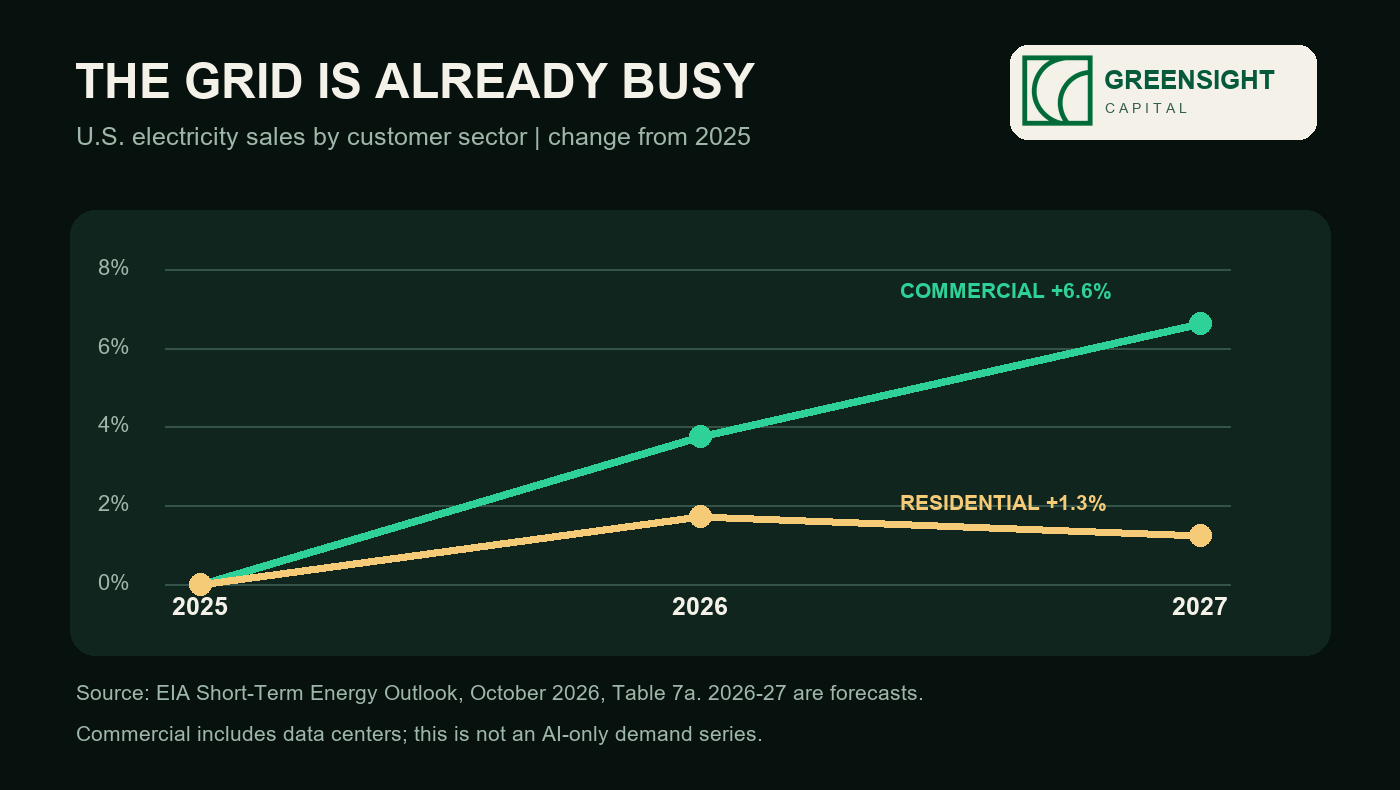
The EIA’s October electricity outlook forecasts U.S. commercial electricity sales, a category that includes data centers, rising from 1,493 billion kilowatthours in 2025 to 1,549 in 2026 and 1,592 in 2027. Residential sales are roughly flat over that span. That’s a broad category, not a measurement of AI alone, but it gives you a feel for the load the grid is being asked to absorb.
If new projects have to prove power availability and customer demand before raising another round of debt, capital goes further. Equipment gets installed where it can be used. Scarce grid capacity has time to catch up. The pressure to spend merely because a competitor announced a bigger number eases. Over the next few years, that should mean fewer stranded assets and a better shot at durable margins. That’s my forecast, not something the election guarantees.
The thing to watch is whether “deliberate” becomes “frozen.” A blanket moratorium that blocks useful capacity while doing nothing for the grid would be bad policy and bad economics. I’m betting on more discrimination among projects, not the end of the buildout.
Where I’d put money to work
Hyperscalers are my defensive AI long. They already have customers, distribution, operating infrastructure, and businesses that generate cash outside a single compute campus. If new capacity gets harder to bring online, existing capacity becomes more valuable. A slower pace may also give them room to digest spending and show shareholders what the investment earns. There is still risk: Amazon’s third-quarter release puts expected 2026 cash capex around $220 billion. Nobody gets a free pass on returns just because they own a cloud.
I also like the grid and power bottleneck solvers. Transmission equipment, storage, efficient cooling, and generation with real interconnection prospects are useful whether the next data center opens in six months or two years. I care more about backlog quality, permits, and who pays for upgrades than a generic “energy for AI” pitch. Clean power can benefit if it is deliverable and economic; a political headline alone isn’t a business model.
The application layer gets more interesting as infrastructure gets pickier. Enterprise software that can point to renewals, saved labor, or higher revenue should keep finding customers. If compute is scarce or expensive, products that use it efficiently have an advantage. This is where I expect the AI story to become less about the size of a data center and more about what the customer does with it.
After the violent selloff in neocloud shares, I don’t think “AI demand slows” is much of a short thesis by itself. Some operators already have meaningful contracted demand; CoreWeave reported a $104 billion revenue backlog at the end of June. Backlog still has to turn into cash, of course. I want to know whether a company has deliverable power, customers who will pay, and financing it can carry. If those pieces are in place, a more deliberate buildout could help scarce, operating capacity. I’m less bullish on uncontracted, permit-dependent projects that need cheap debt and perfect utilization to work.
With chips and equipment, I’m picky about the price. That does not make Lam Research or Nvidia automatic sells. Lam’s latest quarter showed record revenue as chip complexity rose, and Nvidia’s latest reported data center revenue more than doubled from a year earlier. A slower rollout could make orders lumpier without breaking either business. My caution is about paying a straight-line-growth price for an industry that will move in fits and starts.
The market may keep trading this election as a referendum on AI. I think the better question is which companies can make money when they have to build at the speed of the real world.
I still like the buildout. I just want it built to last.
Sources and chart method: Election and market context are as of November 4, 2026. The chart reproduces annual residential and commercial electricity sales from Table 7a of the EIA’s October 2026 Short-Term Energy Outlook, rounded to the nearest billion kWh. The 2026 and 2027 values are EIA estimates and forecasts. Commercial demand includes data centers but is not an AI-only series. Sector outlooks and longer-term conclusions are my interpretation.
Disclosure: This article is for education and general information, not individualized investment advice. The sector views describe an outlook, not a report of personal holdings or trades. Investing in AI and infrastructure involves policy, financing, execution, and demand risks.