

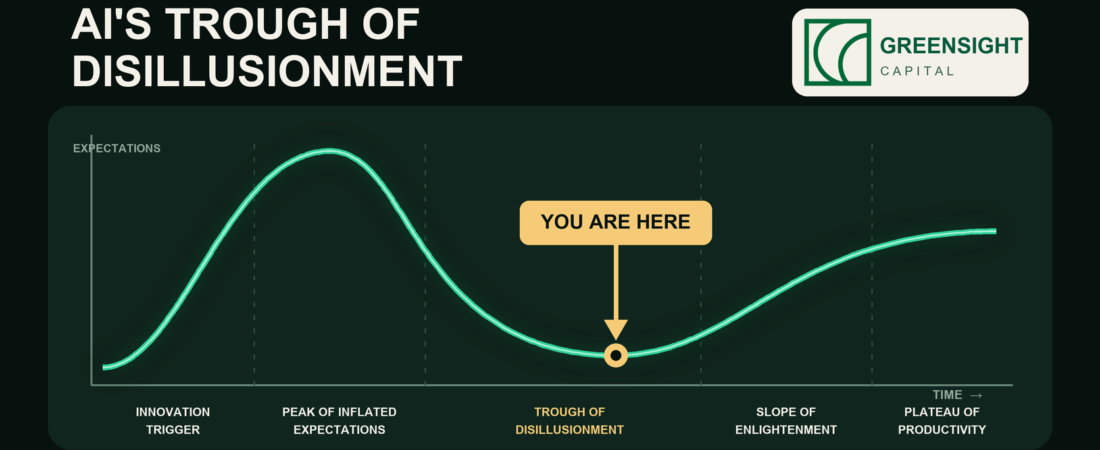
Oh boy. We spent years being told that every AI demo was the start of a new industry. Now people are asking for a return on the billions spent building it. Funny how the questions get more specific when the financing bill arrives.
Gartner says generative AI entered the trough of disillusionment on its 2025 Hype Cycle. I think that describes the market’s mood better than the technology’s capability. The models keep improving. The easy stories are running out.
That difference matters if you’re investing. The peak was a great time to sell a vision. The trough is where you find out which customers will keep paying when a pilot becomes a line item, and which data centers can service their debt when the first contract comes up for renewal.
Credit is asking better questions
Elon Musk’s October 25 post claimed debt markets had almost entirely shut off money to operators without substantial revenue outside AI data centers. He expects a washout among neoclouds. The claim is too broad: Crusoe announced a $700 million financing facility three days earlier. But the warning captures a real change in how lenders are looking at the pile of proposed projects.
S&P Global Ratings said in July that close to 90% of its new project finance and corporate data center ratings this year were speculative grade, pointing to higher leverage and weaker contracts. In August, S&P projected negative free operating cash flow across six major hyperscalers in both 2026 and 2027 as they build. Those are forecasts and a subset of rated borrowers, not proof that all AI credit has frozen. They do mean the capital stack deserves at least as much attention as the GPU count.
The IMF’s October financial stability report makes the risk plain: weaker AI investment or profitability could trigger an asset-price correction, with leverage and concentrated exposures making it worse. That can happen while the technology continues to get more useful. A good product does not automatically rescue a bad loan.
We finally have some numbers
On October 26, Anthropic announced on X that it had filed an S-1. The filing is a better read than the hot takes about it. Revenue was $16.3 billion in the first half of 2026, up from $1.2 billion a year earlier. Compute and infrastructure expense rose from $2.3 billion to $8.9 billion. Anthropic still posted a $693 million operating loss for the half. Those figures show extraordinary demand and a business still spending heavily to capture it.
Read the net-loss headline with care. The filing’s $80.7 billion net loss includes a $72.4 billion fair-value charge on convertible instruments, largely tied to the company’s higher valuation. That accounting charge is not the same thing as cash spent operating Claude. Neither is it a reason to ignore the very real compute commitments and execution risk in the prospectus.
I don’t think Anthropic proves every model company will win. It proves that customers will pay serious money for useful AI, and that even one of the fastest-growing suppliers has to solve some ugly capital-allocation problems. Both conclusions can be true at once.
Where I’d look
Start with customers who have moved beyond demos. Are they renewing? Is usage expanding after the novelty wears off? Does the product save measurable labor or create revenue after inference costs, support, and the human review it still needs? A vendor can have a gorgeous benchmark chart and a lousy gross margin. I want the customer behavior.
Then look at the infrastructure that actually works. Power delivered, clusters running, utilization reported, and contracts that last longer than the debt financing them are worth more than a rendering of a future campus. A credit squeeze can make finished capacity and good operators more valuable while exposing projects built on optimistic schedules. That is where the distressed opportunities may appear, but the debt, lease terms, and customer concentration have to be read first.
Finally, watch the boring integration work inside companies. A 2026 NBER working paper links recent AI investment to productivity gains through organization-specific knowledge built by learning and redesigning work. This is what the productivity J-curve research predicted: new tools need complementary skills and processes before the gains show up broadly. The spending arrives first. The payoff is slower, uneven, and easier to miss if you’re only watching this quarter’s capex.
Some AI stocks and projects will deserve to fall. Some lenders will be right to walk away. But a reset in expectations is how the market starts separating useful technology from expensive promises. I want to find the businesses whose customers and cash flows survive that separation.
I’m bullish on AI. The trough is where the work starts.
Sources and method: Company and market figures are as reported in the linked primary documents available November 2, 2026. The S&P cash-flow projection is a forecast. The opportunity framework and conclusions are my interpretation, not forecasts by Gartner, S&P, the IMF, NBER, or Anthropic.
Disclosure: This article is for education and general information, not individualized investment advice. AI investments involve financing, execution, technology, and demand risks.